
Oswald Spengler in his book, Der Untergang des Abendlandes, termed in English as “The Decline of the West” but transliterated by me as “The Under-descent of the Evening-Landes”, (presumably, into hell in a manner of self-destruction) which by no means reads so strongly as “Decline of the West,” notes each Civilization has its own unique form which it takes.
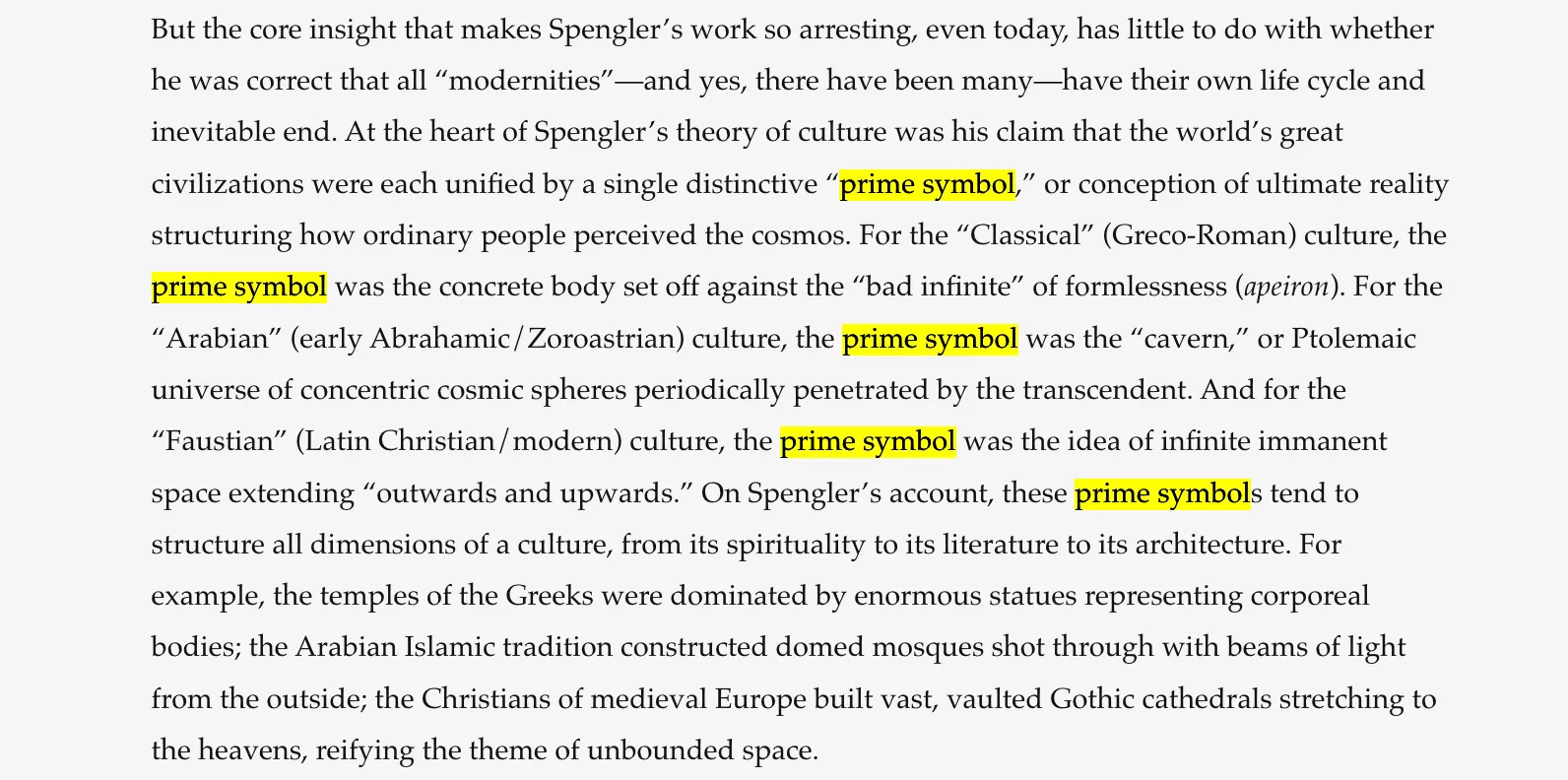
Should it be that the natural form of architecture in different races be the same? Only so much that different races look different. Should they have the same form of language? No, this too is unlikely, because each has its own awareness of the things that it finds important.
I made effort to bring forth this transliteration because each language has its own norms, patterns, and meaning that exists in a self-referential world onto itself. Abend, which means ‘evening,’ and Land, which is a ‘place’ or ‘country’ like Deutschland, is used in words and sentences in a different context than the English word ‘West.’
That is, each word is by itself connected to other words in sentences that give an appropriate context to each weighting of the word. It is imperceptible, slight, yet significant. The association and usage of language shapes how the brain processes and sees information. Therefore, we cannot just translate words—we must translate mental states! And should words be an improper representation of concepts which you feel are wrong, you can choose to use different words, as is the nature of politics!
On Language
The ancients were clearly aware of the importance of language, starting from Herodotus in his Histories in 5th Century BCE.
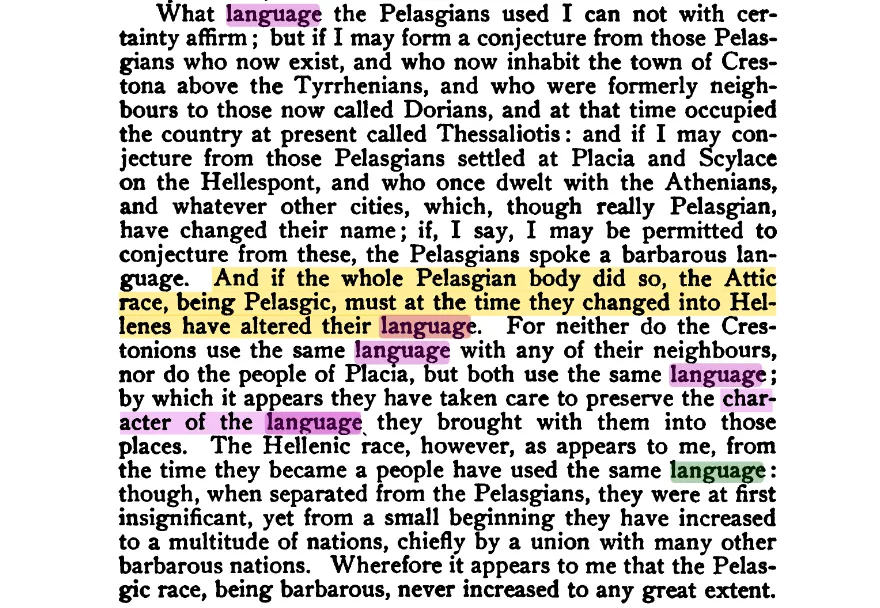
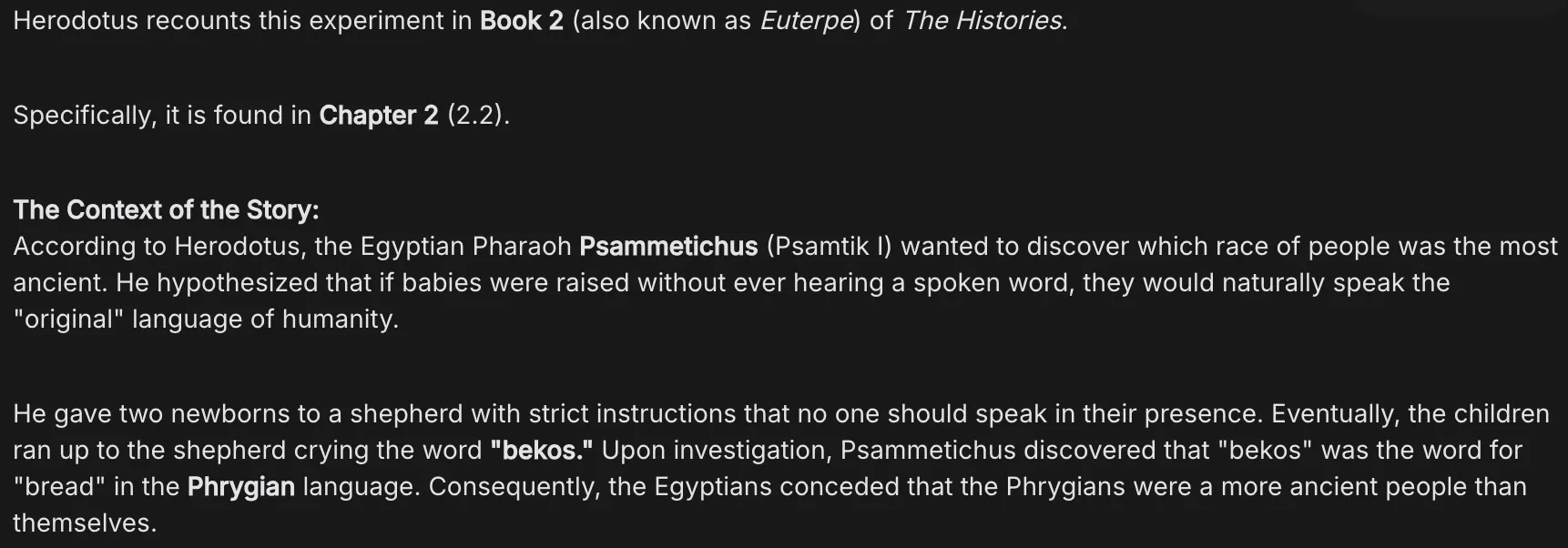
The form of the race is closely associated with the language, and some say there may be an ‘original’ language for which babies are born. But Psammetichus is mistaken here. He believes all humans are the same, and the similarity between a child’s “self-generated” language and relation to extant languages determines which race is more ancient.
My view is that each baby creates the form of original language for their race, which cannot be spoken for humanity as a whole.
I have, in the lates of night, found my grasp of language to slip more toward what is for me may be the original form. The suffixes would get confused and lost, an ‘-ed’ turned into an ‘-ing’ for I believe suffixes to be a Western and not an Eastern trait. The order of words, strangely, became Subject-Object-Verb like Altaic languages as opposed to Subject-Verb-Object of English or Chinese. Of what people was I, thousands of years ago?
I fear that the nature of human language is as such: in the beginning there are idiosyncrasies, so-called archiac forms such as noun-flexion, and different gendered forms. The reason for this is that small groups have shared mutual context which becomes lost as languages grow from absorption. Men and women often have different forms when women from other groups are added on. (Whether small groups of men also absorb into other tribes is unknown).
As more people are added on, these outsiders lose the expressive parts of the language and it simplifies: German loses its genitive form as did English from the admixture of Normans, Vikings, and Anglo-Saxons. The addition of the whole globe changes modern English into simple and dull phrases of nouns and verbs. It may, after some period of time regain degrees of expressivity through the placement of nouns relative to each other, as Chinese poetry is today.
Suffixes and variation in the word seem to be more an organic process than the agglutinative word-joining. The difference of word “slippage,” like emojis go from thinking -> thonking, presents a unique and intuitive feeling different from something such as thinking -> deepthinking.

On suffixes
What is an “-ist”? What is a biologist, a chemist, a physicist but someone who believes in things related to biology, chemistry, and physics? And thus a race-ist is just someone who believes in the differences of human race, which is in our modern day conflated with the “raycist = bad” definition.
And if your mind finds it difficult to distinguish this raceist and raycist, much like one may conflate affect and effect, all of which are pronounced differently such as marry, Mary, and merry, then by all means you should stop reading here.
I am not a race supremacist, which is what most people mean when they say raycist, and I think the simple cruelty which comes from it is unwarranted and unnecessary. And any semblance of supremacy must come from innate values which put one above another, of which self-aggrandizing can only be considered lowering.
But I am a race scientist, and I do see the differences between types of people, as I do men and women, contingent upon biology.
Moreover, that makes me a race realist, where I see how differences suited for varying natural environments in self-reinforcing loops shaped culture and biology, which affects the outcomes and interests of different groups today.
We in the East observe certain truths written by Evola, Schuon, or Guénon. But I believe the overall outcome or conclusion is that Eastern races see themselves relative to Western races, as Western races see themselves relative to Southern races. I say I believe, for no future is certain and no guarantee is for sure. It is a timeless story that self-assuredness sows the seeds of one’s demise. And yet, I speak of this only at the highest levels, of which I have seen many of numerous types of all races which possess to themselves power and expressivity.
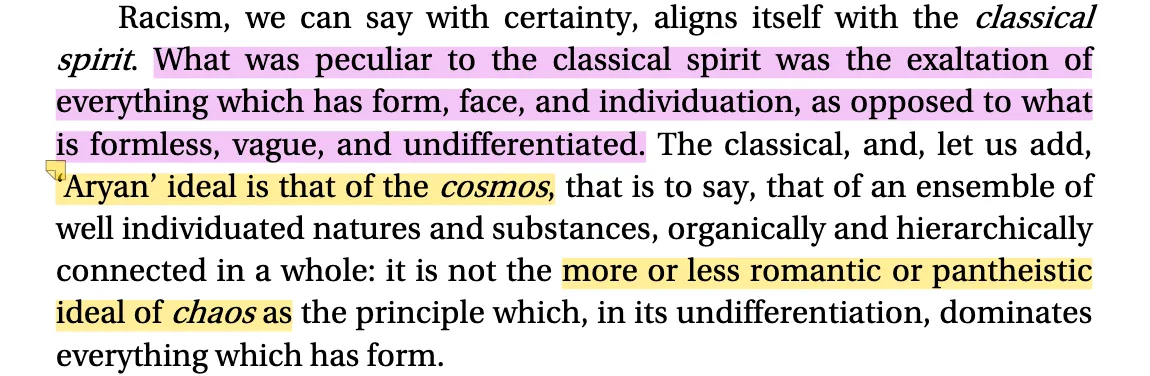

What is for certain, however, is that I know myself, and I know what forms of being are closest to forms natural for me. Moreover, I see superiority as not only spiritual; it is the biological, metabolic, material, and theoretical which infuses the spirit with action.
ABSTRACT and EMOTIONAL language
Language itself has two ways of expression, and they are often mutually exclusive to one another.
If language is used for emotional purposes, that is, to engage feelings in the brain which make one feel good such as “wow, I like your shirt!” or “you are amazing!” this presents a destructive usage of the language; it accumulates no information except for greater friendliness among people who associate by such styles.
The distinction between abstraction and emotion are those who associate by competence and hierarchy or those who associate based upon these social “feel-good” feelings.
What is the meaning and significance of language? If you have not thought about it, then it is easy to take for granted in that language simply seems to be a matching to whatever national standard there is—Merriam-Webster or the Oxford Dictionary.
But there is a much older view: that language is the expression of the race itself, inseparable from the way one views the world. For how the Inuit have dozens of words for snow and ice, or how the engineer’s lexicon differs from the median person, we can see that different words highlight one’s perception in different ways.
English is by its nature a more emotional language. It uses variance in the word and italics to denote stress and meaning. Ancient Greek seems to flow off the page, the variances in amplitude and wavelength captured in the text itself. Yet, it is possible to distill it down to analytic forms, which are not as semantically compressed as Chinese, rows of boxes upon boxes, context upon context.

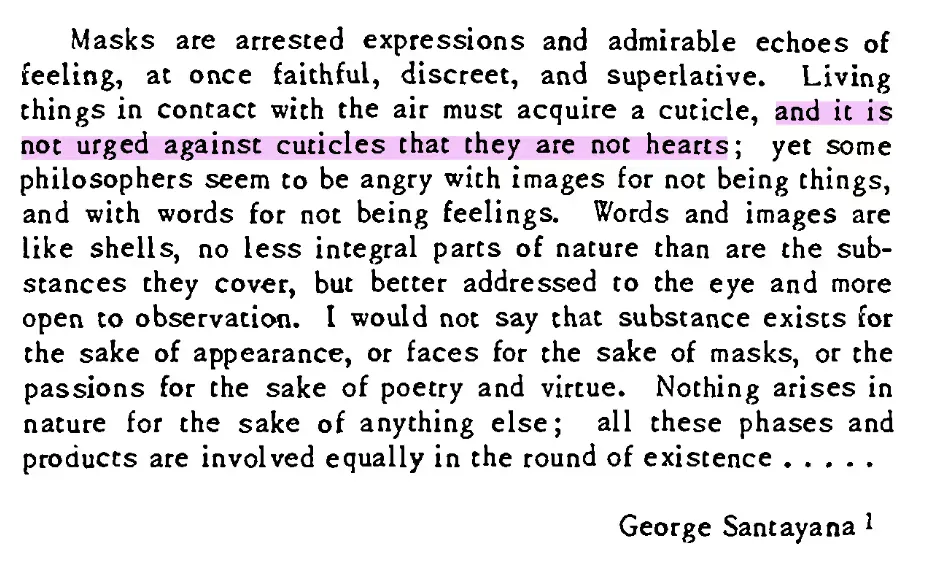
Furthermore it includes the anthropomorphization of countries: it becomes a “she,” a “motherland,” or a “fatherland.”
But the aforementioned is the tendency of the European race and its descendants, which is now different from the European-Bantu hybrid speech now present in the United States. From where could terms such as “T-boned,” “rear-ended,” “holds sway,” or “clout” come from?
Language has a purpose and a goal. It can communicate understandings or it can be used to evoke emotion from others. We define the former as abstract-material language while the latter is social-emotional language. By playing emotional games, you lose the ability to use language to accumulate higher levels of knowledge; this prevents you from developing organized strength. Those in high level positions may constantly propagandize things to weaken others’ social intuition: saying that one should study techne instead of philosophy, as did Karp at Davos.